
With all the doom and gloom about U.S. house prices, investors are sitting on the side lines waiting for the “bottom”. After all, the Case-Schiller Index, now widely recognized as the best measure of overall house price levels in the U.S., continues to drop. If you follow the headlines in the mainstream media, it would be easy to conclude that house prices are still declining and real estate should be avoided as an investment.
Yet, there is more to this story. People who think house prices are still going down should think again. And anyone with cash to invest should take a serious look at certain sectors of U.S. residential housing right now, while the getting is good.
Ignore The ‘Average’
Our reasoning begins with the idea that the foreclosure crisis did not hit all areas of the country at the same time, and it did not impact all types of homes at the same time. So basing one’s decisions on overall average price levels across the nation is not a very good idea. That’s like deciding not to buy any stocks because overall average stock indexes are falling. Everyone knows that some stocks can rise even while average stock prices are falling. It’s no different with real estate.
The Lower-End Was Hit First
The first home owners to get hit by falling house prices were the sub-prime borrowers. Typically, sub-prime borrowers purchased lower priced homes. So owners of lower priced homes were probably the first to stop paying their mortgages, the first to lose their jobs, and the first to default and be foreclosed on by the banks. Lower-priced homes were the first to be liquidated back on the marketplace, at much lower values than the original price paid.
As the housing crisis advanced, owners of larger, more expensive homes were watching the damage and holding on to their homes, hoping and waiting for a rebound. It’s quite likely that an owner of a larger, more expensive home probably had more “cushion” (either in terms of savings, investment assets, or employment income) to weather the storm and hope for some sort of turn around in the market. Owners of these larger homes were not the first group to mail the keys to the bank. Unfortunately, housing prices continued to drop to the point where even larger more expensive homes began to enter foreclosure.
Our conclusion is that while the “average house price” continues to decline (albeit marginally relative to previous declines), this is largely due to the more recent phenomenon of bigger, more expensive homes entering foreclosure.
Sunshine States: Hit First and Hit Worst
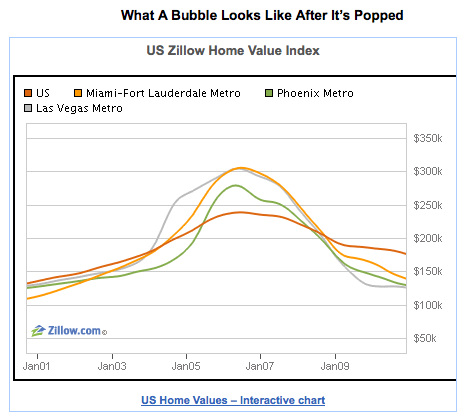
The sunny states of California, Florida, Nevada and Arizona were also the first to experience the crash. This was due to excessive speculation in these areas. We believe lower priced homes in parts of California, Nevada, Arizona and Florida are probably not going down and could already be on the rise even though the average statistics would disagree.
House price values in the worst hit States will undoubtedly accelerate upwards once the banks finally purge those homes from their balance sheets. The first to be hit, will also be the first to recover as the banks work off their inventory of foreclosed homes. Once bank foreclosures are removed from the marketplace in any particular price segment, and they are surely getting close at the lower end of the market, prices in those categories will jump. However, the larger McMansions, many of which are just now entering foreclosure, could continue to pull the “average” downward for some years to come.
In other words, start investing where the crisis began because those areas probably have bottomed, and it’s likely that the banks will soon run out of foreclosure inventory at the bottom end of the market.
The Bubble Has Fully Burst
We were unable to find statistics to prove our theory that lower-end homes will bottom before higher-priced homes, because house price trends are not broken down into price categories. However, this chart seems to indicate the bubble has fully “burst” in the first and hardest hit markets.
Demographics Will Drive The Rebound
The irony is that the States with the greatest speculative buying were the hardest hit but will also likely be the first to recover and recover with the greatest strength. This is because the baby-boomers, over 40 million strong and now just beginning to retire, will be looking south to warmer climes for their retirement. While some of you are wisely looking at places like Mexico, Costa Rica, Thailand, Panama and Ecuador, most of the American baby boomers will settle for Florida, California, Arizona and Nevada. The real estate bust has created a once-in-a-generation buying opportunity for baby boomer demographic segment, and their movement will help the overall economies in those markets.
Houses Are Made Of “Things”
Another reason to buy real estate now is the huge run up in commodity prices since the crash of ’08, which hints at the possibility of significant inflation.
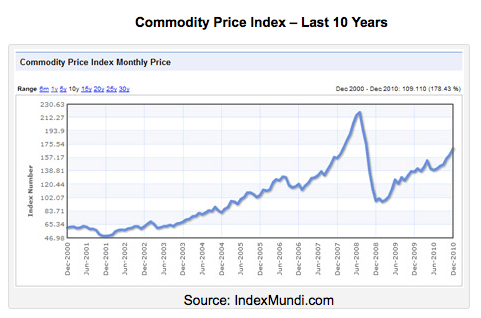
Prices of copper, tin, lead, and almost every other commodity one can imagine have soared since the depths of the ’08 crash and are up 23% in the last year and 178% over the last 10 years. Well, we have news for you… houses are made of “things” (ie. commodities).
It’s true that houses are not composed of the same materials used to create the Commodity Price Index identified in the chart above, but the same forces drive up prices for the same things houses are made of like lumber, granite, stainless steel, tile, etc. with labor being the only exception. We were unable to find statistics on home construction labor rates but we doubt they are lower today than they were in 2001. This means the cost to build a home has gone up substantially over the last 10 years but the cost to buy a home has not… hmmmmm.
With commodity prices rising 178% over 10 years, and house prices in places like Las Vegas losing value over the same time frame, one might conclude that house prices are undervalued in relation to the materials used to build them. The fact is, in most cities in the U.S. today, houses are selling for less than the cost of construction, excluding the value of the land! We like to buy things that are priced below their replacement value, and if we get land for free, all the better.
So here we are with stocks and commodities having rebounded and recovered nearly all of their pre-crisis value, yet housing, which was the initial cause of all of the world’s financial problems has lagged way behind. Translation: if anything is worth buying, it’s housing.
Mortgage Rates Are Still Historically Low
With mortgage rates as low as they are, we would encourage anyone with stable income and plans to remain put for a few years to buy a house now while the getting is good and lock in your mortgage rate for as long as you can. The overnight Fed funds rate is already at zero and can’t go lower. Cheap financing makes the argument to purchase a home that much more compelling.
Is The Economic Recovery For Real? Who Knows, Who Cares?
If the U.S. economic recovery is real (and we have our doubts), housing will eventually pull itself out of the dumps as employment levels improve. And if the economic recovery continues to stagnate or gets worse, at least you will have a house to live in or rent out.
The point here is that our argument for buying housing is not based on the assumption that economic or employment conditions will improve in the U.S. over the short to mid-term. Our argument is that housing is a good buy either way, as long as you invest in the geographic areas and price categories that were the first to crash and crash the hardest.
Stocks Have More Downside Risk Than Housing
If there are further economic shocks, it is likely to affect stocks much more negatively than houses. Stocks have recovered almost all of their pre-crash value, while residential real estate hasn’t recovered at all. In our view, US residential housing in the worst hit states like Florida, California, Arizona and Nevada is, in general terms, a much safer investment today than stocks, which are (literally) banking on more free money from Ben Bernanke.
House Prices Vs. Rents Are Historically High
It is not only house prices one should consider when looking at housing as an investment, it’s house prices in relation to house rental rates. Well, here too, rental rates are at historically high levels in relation to house prices in many cities across the U.S. especially at the lower end of the market. This is because when people are foreclosed on, they can no longer buy due to damaged credit. Well, those people don’t disappear from the planet… they rent. With a plethora of tenants in the marketplace rents have managed to maintain their levels throughout the housing bust, making the buy-to-rent investment even more attractive.
Housing A ‘No-Brainer’ For Cash Buyers
Investors with cash are in an excellent position to capitalize, and are almost guaranteed to benefit in this market. Anyone who has been out shopping for foreclosed homes in markets that are supposedly “still declining” like Las Vegas, will know that investors with cash are competing with each other to purchase bank owned properties – that’s right – competing with each other (sounds very 2005, doesn’t it).
It’s a fact that in some cases investors are bidding higher than the bank’s asking price in order to purchase a foreclosed home in a high-demand location. Why? Because all of the non-cash buyers in the market, most of whom require an FHA insured mortgage to purchase a home with 3% down, cannot purchase foreclosed homes from the banks. The banks are only looking at cash offers for bank owned real estate. So the FHA buyer must select only from non-bank owned properties, which are typically priced much higher than those the banks are selling.
The result is that investors are purchasing from the banks with cash, making minor renovations, and “flipping” these homes to a buyer requiring an FHA insured mortgage, often for a price as much as 50% higher than the price they paid. Is this fair? Absolutely not. But rather than whine about it being unfair, wise investors need to take advantage of market inefficiencies whenever they present themselves. This is how capitalism works to re-balance markets.
Forget Wall Street, Invest In Main Street
Why haven’t investment analysts or the mainstream financial media been alerting people to the opportunity in U.S. housing? A few reasons… first, most media reporters just focus on one number – U.S average house prices – and conclude housing is still declining. Most mainstream financial media reporters are not out shopping for real estate in the worst hit cities and realizing how strong demand is from private cash investors.
Second, investment analysts don’t make any money selling houses, they make money by selling you investment securities. Wall Street is not in a position to purchase residential homes one by one from banks, it’s not worth their time. It was easy for Wall Street to buy mortgages on a grand scale and re-sell them to clueless pension fund managers all over the world, but it’s not so easy to play the game in reverse, because there is too much effort involved for too little money (that said, private investment funds are popping up everywhere to scoop real estate deals from banks and distressed developers, and some media stories have begun to pick up on this).
Be A Contrarian Investor
Conclusion? Money is made in a boom, but fortunes are made in a bust. Contrarian investing makes sense. When most people are selling, you should buy, when most people are buying, you should sell, it’s that simple. Anyone who says it is a bad time to invest in U.S. real estate is not looking closely enough at the true dynamics of this market. It is almost as easy to make money in U.S. real estate today as it was 5 years ago, the only difference is that today, you need your own cash to play the game, not the bank’s.
Original article: Here